What to charge for passport photos with a digital code
Pricing guidance for UK photo shops selling passport prints plus a digital Photo Code — market anchors, margin maths, and package ideas.
Customers will pay for a Photo Code if you sell it as part of a clear package. They will not pay extra for a mumbled “and we can do a digital thing as well.” This note is for UK shop owners setting a counter price — not for people making a free personal code at home.
You are an independent photo business. A higher price does not make the photo more official, and no fee can guarantee HM Passport Office acceptance.
What customers already think it costs
Walk-in prices are noisy, but three anchors show up again and again:
- Booths and unstaffed machines: roughly £6–12 for a set of prints, sometimes with a code included in the booth offer.
- Staffed high-street counters (pharmacy, supermarket photo, chemist): roughly £12–16 for a standard UK set, often with a digital option bundled or as a small add-on.
- Specialist studios and camera shops: £16–25+, especially if you include retakes, a seated shoot, or international sizes.
Those ranges are market observations, not recommended prices. A village chemist and a city studio should not copy each other. Use them so you do not accidentally undercut the booth by £1 and still do all the staff work.
Price the package, not the code
The code itself is a short reference. Customers understand prints + code more easily than “digital licence item”. Three packages cover most counters:
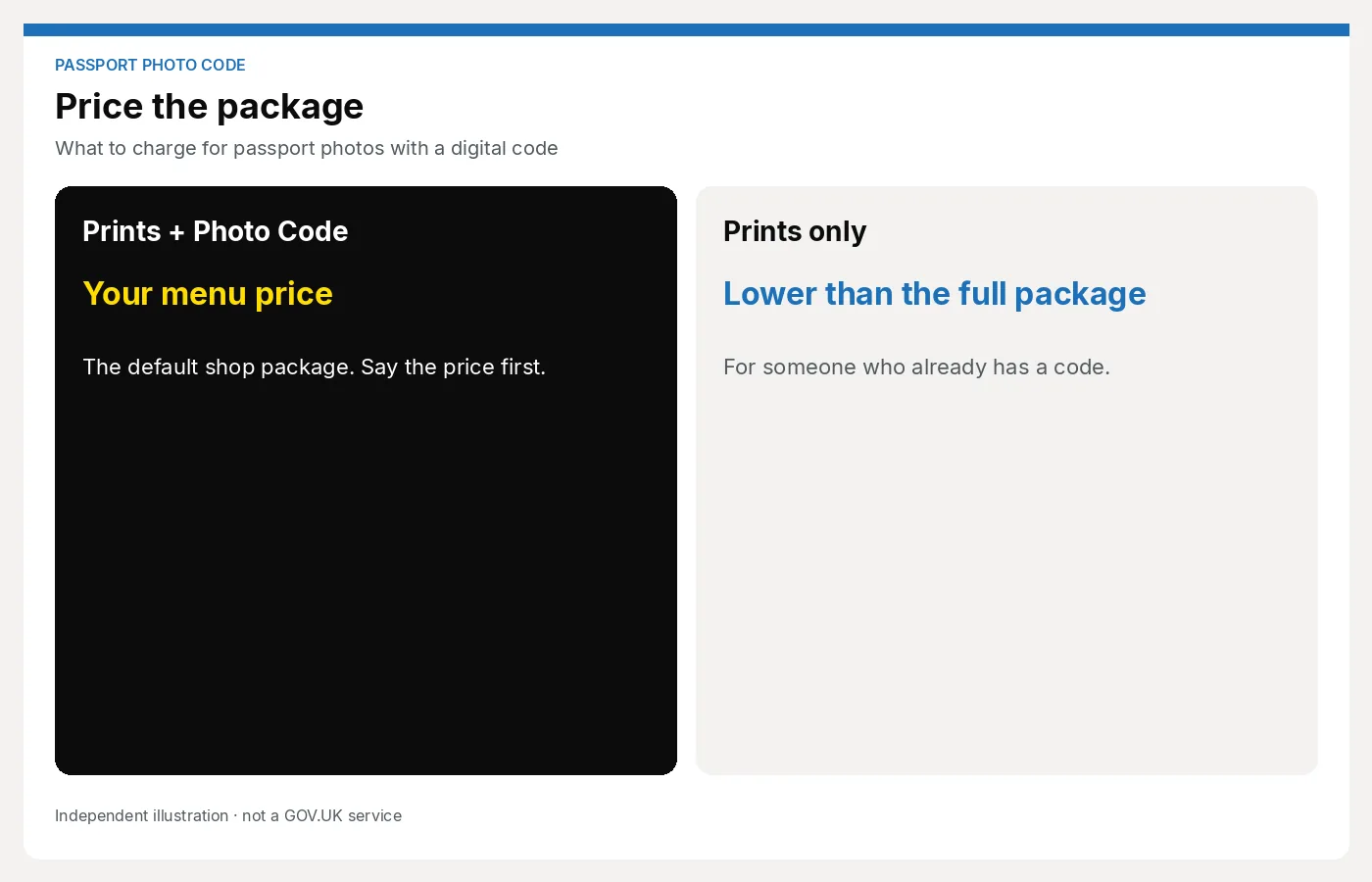
- UK set with Photo Code — the default. One shoot, prepared digital photo, written code, and a print sheet. This should be your menu price, not an afterthought.
- Print-only — for postal renewals, a second application, or a customer who already has a code elsewhere. Price it clearly below the full package so the upgrade is obvious.
- International / extra sizes — visa, foreign passport, or a second crop. Charge for the extra preparation, not for “another code” unless you actually issue one.
A fourth package is worth having if you see families:
- Baby or young child — same digital + print outcome, but you are selling time and patience. A modest premium is fair; a huge premium needs a private room or a dedicated slot.
Write the four prices on a card at the till. If the only number staff remember is the old print-only price, every code becomes a negotiation.
A simple margin sum
Work backwards from what you keep after the obvious costs:
Price − (print media + staff minutes + software or pack cost per job) = contribution
Example, using round numbers for illustration:
- You charge £14.95 for UK prints + code
- Paper/ribbon for the sheet: £0.80
- Five minutes of counter time at a loaded staff cost of ~£15/hour: £1.25
- Software or pack cost: from a few pence (well-used annual pack) to a larger share if you under-use an allowance — see the DNP-style pack comparison
Contribution in that sketch is still comfortable. The job that loses money is the one that takes fifteen minutes because nobody has a script, or the one you discount to “match the booth” after a ten-minute shoot.
Watch these leaks:
- Free retakes without a rule. One retake for blinks or a baby is goodwill. Unlimited retakes are a different product.
- Unpriced reprints. A second sheet next week is not part of the original job unless you said so.
- Pack waste. An annual code allowance that you barely use is a fixed cost dressed up as a cheap unit price.
How to sit relative to the booth
You will not win on “we are 50p cheaper than the machine.” You win on:
- A person who checks glasses glare and shadows before the customer leaves
- A code written down so it can be typed later
- Prints in the bag for the paper route
- A baby or wheelchair-friendly shoot that a booth cannot do
Price at or a little above the staffed high-street band if you offer that service. Price below specialist studios if you are a pharmacy till, not a portrait studio. If a competitor advertises “code included” at £9.99, do not assume they are making money — assume they are buying footfall.
A counter script that protects the price
Keep it short and the same for every colleague:
“For a UK passport we do a set of prints and a Photo Code for the online application. That’s £14.95. The code is how the photo reaches the form; HM Passport Office still decides whether to accept it. I’ll write the code down for you.”
If they only want prints: give the print-only price in the same breath. If they ask whether the code “guarantees it goes through”: say no, calmly, once.
Do not send studio customers to the free personal tool on this site. That path is for people preparing their own application, not a shop job.
When to raise the price
Raise the package price when:
- You now include the code as standard and still charge the old print-only figure
- Staff time has gone up (more baby appointments, more glasses checks)
- Local staffed competitors have moved and you have not looked for a year
Hold the price when the only pressure is a booth poster. Match the service, not the sticker.
How Passport Photo Studio affects the sum
Passport Photo Studio is a browser workspace: digital photo, Photo Code and print sheet without a DNP-style annual pack or a desktop install. That does not set your retail price — you still charge what the local market will pay for a staffed job — but it stops the software line from being a large, unused annual bill.
If you are still choosing a stack, the studio buying guide covers lock-in and workflow. For the till itself, pick a package price, write it down, and make the code part of the default UK set.
Next step for studios
Set the package, then give staff a workspace that matches it: For photo studios.