Can you smile in a UK passport photo?
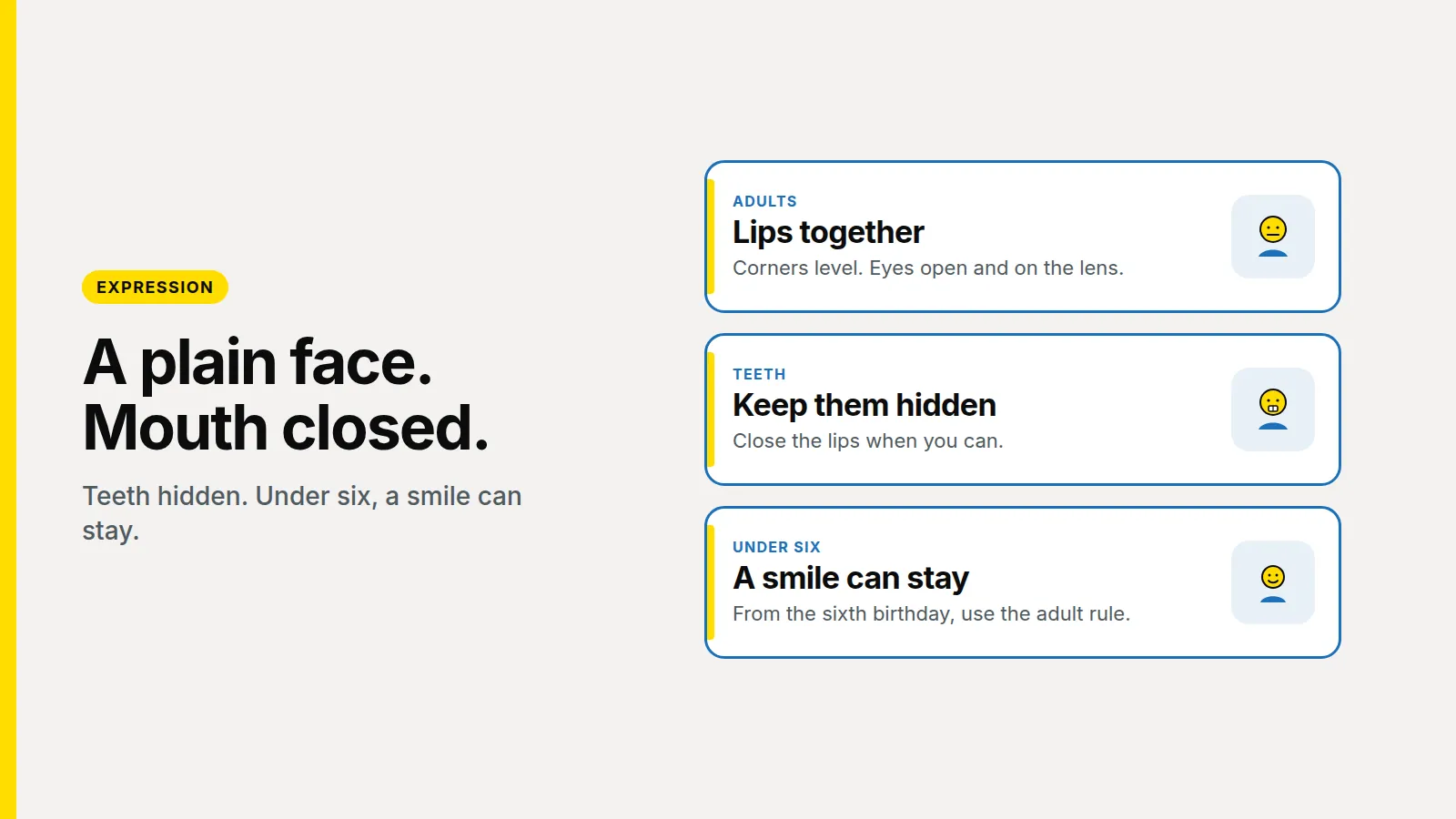
Adults need a plain expression and a closed mouth. Teeth stay hidden. Under six, a smile can stay. How to hold the face, then get a Photo Code.
No. For an adult, a UK passport photo needs a plain expression and a closed mouth, with the teeth hidden. Photos for passports says you face the camera, eyes open and visible, with no hair across the eyes. Rules for digital photos puts the expression in one line: a plain expression, no smile, mouth closed. Children under six are the exception. That age split is below.
Updated 10 November 2026. Passport Photo Code is independent of GOV.UK and HM Passport Office. HM Passport Office makes the final decision on every photograph.
Can an adult smile in a UK passport photo?
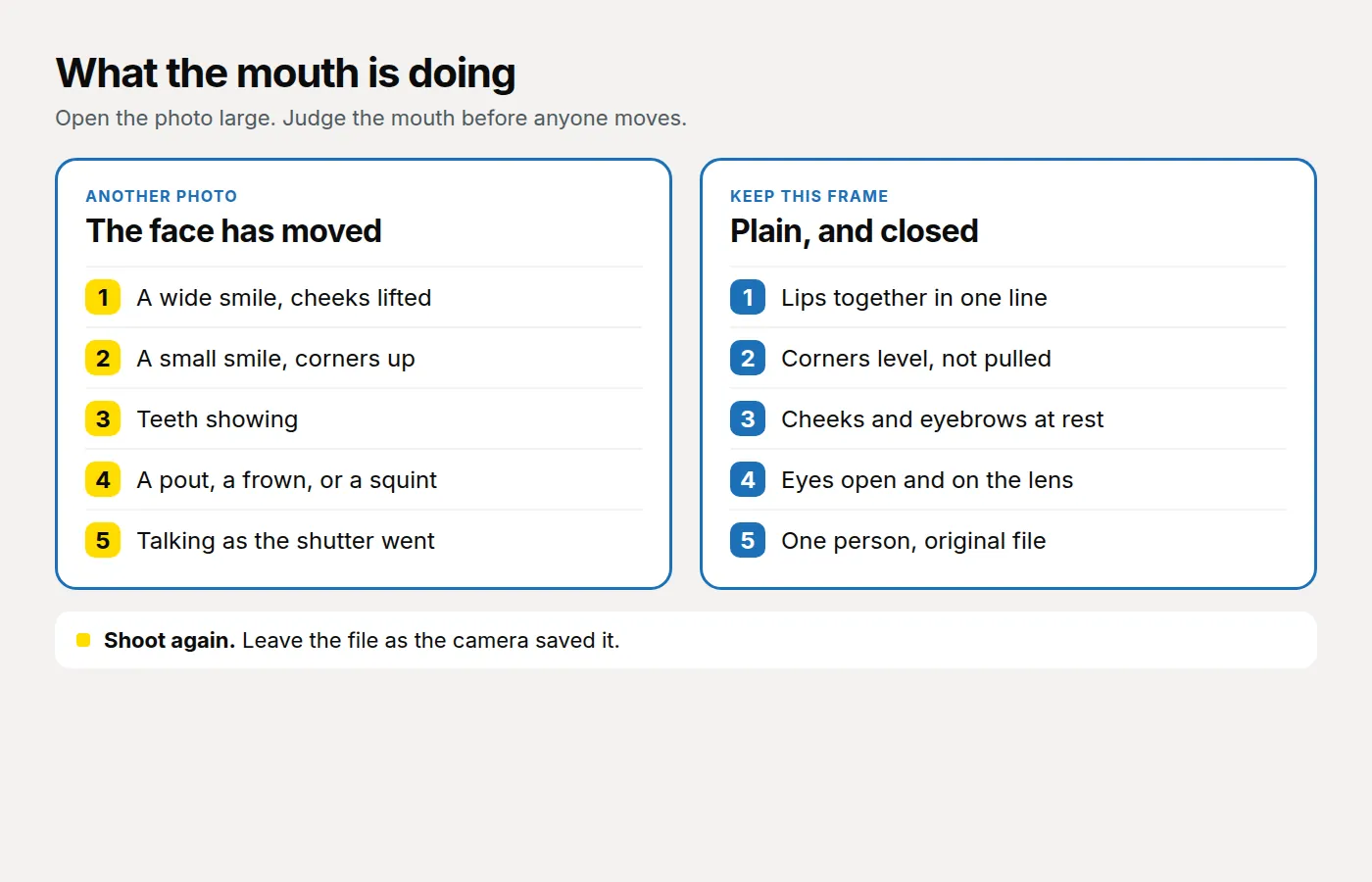
No. How to take a digital passport photo says don’t smile or frown, eyes open and mouth closed. Printed photos uses the same sentence, so a paper form matches the online form. The taking guide calls smiling by accident a common mistake. When the corners of the mouth lift, shoot again.
| What the face is doing | What to do |
|---|---|
| A wide smile, teeth showing, cheeks lifted | Another photo. |
| A small smile that still pulls the corners up | Another photo. |
| Lips together, jaw relaxed, eyes open, looking at the lens | Keep this frame and check it large. |
| A frown, a pout, raised eyebrows, or a squint | Another photo. Those change the face as well. |
| The mouth open because you were speaking | Close the lips and shoot again. |
| One corner of the mouth higher than the other | Another photo. A smirk still changes the mouth. |
| You cannot close your mouth, or hold a plain expression, because of a disability | Keep a true likeness and explain it. The letter is below. |
| A child under six smiling | The smile can stay. The age rules are below. |
Photo standards, version 51.0, is written for examiners. That GOV.UK page was updated on 4 March 2026. It tells them to reject an expression that changes the shape of the face, and it names smiling widely, pouting and frowning. It says that kind of expression can stop the system from capturing accurate biometric information. Shoot with the lips together. A smaller smile is still another photo once the corners have lifted.
Can you show your teeth?
Leave them hidden if you can close your lips. The public pages say the mouth is closed. An old passport that shows a small gap is not the rule for this sitting.
Photo standards tells examiners to reject an open mouth when that changes the shape of the face. It tells them to keep a relaxed mouth where the teeth show or the lips are slightly apart, when the features are not distorted, and to keep a photo when the person cannot close their mouth because of a medical condition.
- You can close your lips. Do that before the shutter. Teeth showing means another photo.
- A thin line of tooth, with the cheeks and eyes unmoved, is the relaxed mouth examiners are told to keep. The taking guide still says mouth closed. Shoot again with the lips together.
- If a disability means the mouth cannot close, submit the photo and explain. The taking guide asks for that when a religious or medical reason is why a rule cannot be met. The letter is on passport services if you’re disabled. What to write, and when to send it, is in UK passport photos for elderly and disabled applicants. A smile you can drop means another photo.
Leave the mouth alone in an editing app. Photos for passports says the file must be unaltered by computer software. Examiners are told to reject a digitally enhanced face, including features made larger or smaller.
What should you look for when you zoom in?
Open the picture so the mouth nearly fills the screen. The camera preview hides a single tooth.
- The lips meet in one line, with no gap and no tooth, and the corners sit level.
- The cheeks have not bunched, and the lower lids have not been pushed up. Lines that are already part of your face stay.
- The eyebrows sit where they rest. The lips touch, and they are not pressed into a hard line.
If a line fails, shoot again in the same spot. Keep the camera’s original, with head, shoulders and upper body in the frame. A crop, a filter or a screenshot is a different picture.
Why do photos at home come out smiling?
A normal portrait asks for a smile. A passport photo asks for a plain face, and the habit wins at the shutter.
| What happened | What to change |
|---|---|
| The helper said “smile”, “cheese”, or “say passport” | Agree the words first. The cue is “lips together”, then silence. |
| You watched yourself on the phone screen | Look at the lens. Prop the phone, or hand it to someone else. |
| You answered a question as the shutter went | Finish talking. Close the lips. Then take the photo. |
| You laughed because a child laughed | One person in the frame. Take the adult photo once the child is out of shot. |
| The flash made you squint, and the squint pulled the mouth | Flash off. Face a window. The taking guide asks for natural light. |
| You pressed the lips hard, trying to look serious | Release the jaw and let the lips touch. |
Stand about 50 centimetres from a plain light wall. The person with the camera stands about 1.5 metres away, rear camera at face height. The full room setup is in how to take a UK passport photo at home. Hair, clothes and a head covering that must stay are in what to wear for a UK passport photo. Glare that makes you squint is in can I wear glasses in a UK passport photo.
How do you hold a plain expression for the shutter?
- Use the distances above. Face a window, flash off, and switch off a ceiling light that throws a shadow. An arm’s-length selfie widens the face and makes the mouth harder to judge.
- Hair off both eyes. Glasses off unless you have to wear them for this photo. Nothing covering the face. One person in the frame, with head, shoulders and upper body included.
- Look straight into the lens. Head upright. Let the jaw hang loose, then bring the lips together without pressing. Cheeks and eyebrows stay where they are.
- Breathe out. The helper waits until that breath is finished, then takes the photo, and stays quiet.
- Take three or four frames. Open the sharpest one large before anyone moves. If you see a tooth or a lifted corner, say so, then “lips together”, and shoot again.
On your own, prop the phone at face height about 1.5 metres away and use a timer. Ask someone else when you can. The taking guide is written that way.
Can a baby or a child smile?
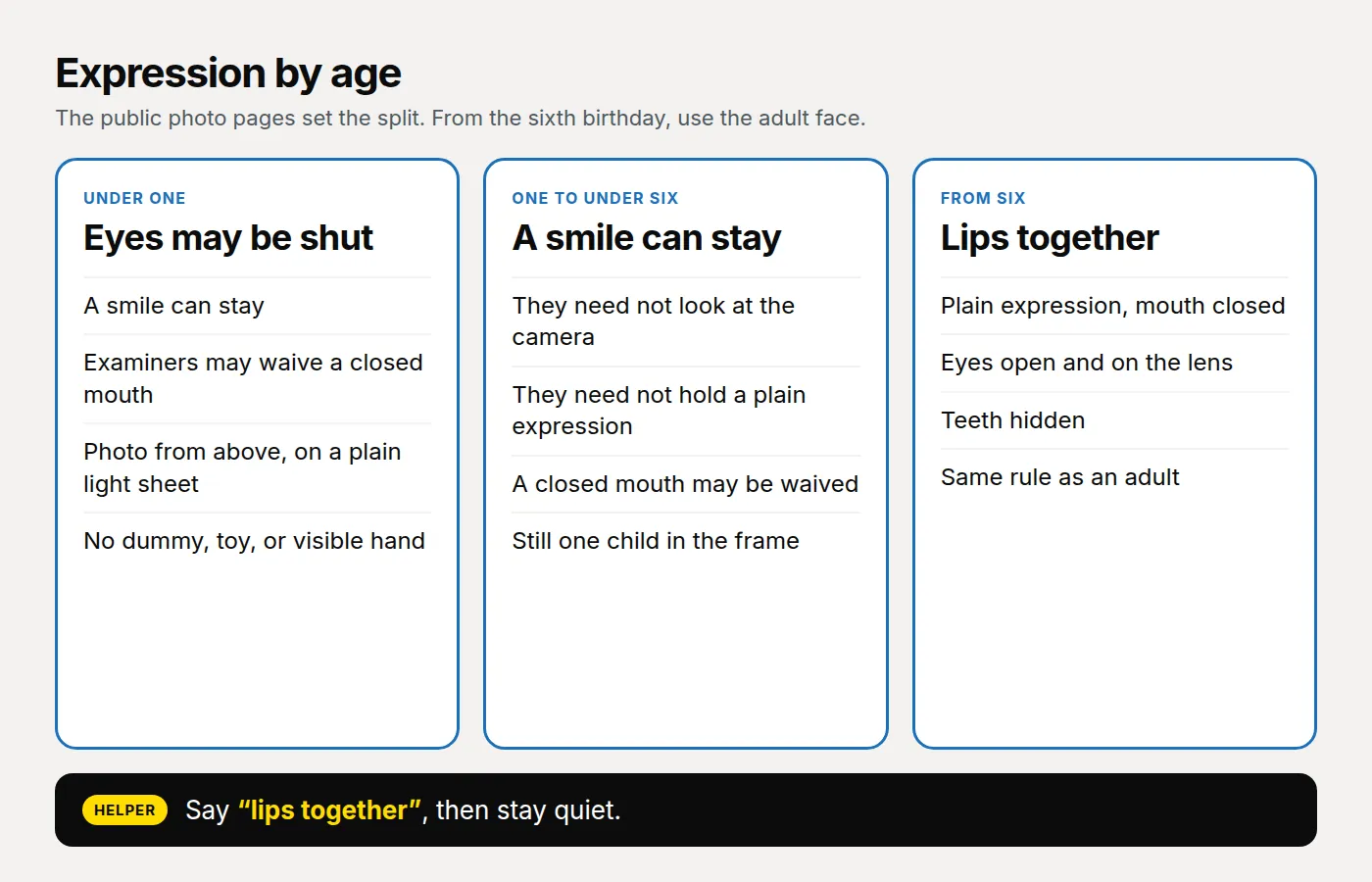
Yes, under six. From the sixth birthday, use the adult rule.
| Age | Expression and mouth |
|---|---|
| Under one | The eyes need not be open. Examiners may also waive a closed mouth. Photograph from above, on a plain light-coloured sheet. No toy, no dummy, and no hand in the frame. A smile can stay. |
| From one until the day before the sixth birthday | They need not look at the camera or hold a plain expression, so a smile can stay. Examiners may waive a neutral expression and a closed mouth. The child is still alone in the picture. |
| From the sixth birthday | Plain expression, mouth closed, looking at the camera, eyes open. The same rule as an adult. |
The public page states the under-six expression rule and the under-one eyes rule. The closed-mouth waiver for under-sixes is only in Photo standards. A calm closed mouth on a five-year-old is worth keeping when you can catch one. From the sixth birthday, “give us a nice smile” produces the wrong frame, because children copy the adult behind the camera. A dummy, a toy and a supporting hand stay out at every age. A first child passport is in what photo you need for a child’s first UK passport. A baby on a sheet is in UK passport photos for babies and young children.
How do you get a Photo Code once the expression is right?
From the homepage, choose Create my photo & code, or open the create page. The same order is on online passport photos. Upload the original. We check and format it to meet GOV.UK photo rules. Look at the preview before you pay. On an adult, a smile, teeth, or an open mouth means another photo. The checks on this site are not HM Passport Office’s decision.
You pay £2.99 once, for the Photo Code and the digital passport photo together. There is no subscription. The code can be used for an HMPO online application. On the form, enter the code and look at the mouth on the picture that loads before you submit. The passport fee is separate and is paid to HM Passport Office. This order does not post prints. A paper form still needs two identical prints, sent loose. What happens after payment is in how to get a Photo Code online.
A short version of the photo rules is on our requirements page.
Frequently asked questions
Can I smile in a UK passport photo?
Adults, no. The public pages ask for a plain expression and a closed mouth. A smile that lifts the mouth means another photo. Under six, a smile can stay.
Can I show my teeth if I am not smiling?
Close the lips if you can. Examiners are told a relaxed mouth with teeth visible can stay when the features are not pulled out of shape. The taking guide still says mouth closed, so lips together is the frame to shoot.
Is a very small smile all right if my eyes stay the same?
Shoot again when the corners of the mouth have lifted. Smiling by accident is a common mistake on the taking guide. Examiners are told to reject an expression that changes the shape of the face.
Can my child smile in a passport photo?
Under six, yes. They need not look at the camera or hold a plain expression, and examiners may waive a closed mouth. From the sixth birthday, use the adult rule.
Can a baby’s mouth be open?
Under one, the eyes need not be open, and examiners may waive a closed mouth. Photograph from above on a plain light sheet. A dummy, a toy and a visible hand stay out. The public pages still bar a dummy.
Can I close a smile with an editing app?
No. The photo has to be unaltered by computer software. Take another frame with the lips together.
What if a disability means I cannot hold a plain expression?
Submit the photo and explain. Passport services if you’re disabled sets out the letter, and our guide covers what to write and when to send it. A smile you can drop means another photo.
Who decides whether the expression meets the rules?
You and your helper check the preview, then look again on this site before you pay. HM Passport Office makes the final decision. A Photo Code can be used for an HMPO online application. It retrieves the picture. It does not decide the expression.
Sources
- Digital photos and printed photos
- How to take a digital passport photo and rules for digital photos
- Photo standards, version 51.0, page updated 4 March 2026
- Passport services if you’re disabled